Financial Security: How Big Should Your Emergency Fund Be?

Reading time: 9 minutes
Last month I was standing in a café in the Loop in Chicago when my phone rang. My washing machine had spun its last spin. $1,200 for a new one. While I paid for my coffee, I thought: three years ago this call would have sent me into a panic. Today it doesn't. The difference? My emergency fund. Financial security begins exactly here, not with stocks or real estate.
I'm Selina, a finance blogger from Chicago, and I've experienced firsthand what it's like to live without savings. The question isn't whether, but when the next unplanned expense will come. The right size of your financial reserve decides whether you handle such moments calmly or slide into the debt trap.
Why an emergency fund is the foundation of your financial security
An emergency fund isn't just money in an account. It's your safety cushion against job loss, illness, car repairs or broken household appliances. Without this reserve, you reach for the credit card or a consumer loan at every financial squeeze. That's exactly how my own debt spiral began a few years ago.
According to a 2023 study by the University of St. Gallen, 41 percent of Swiss households don't have sufficient savings for unplanned expenses over 2,000 Swiss francs. That number scared me, but it also confirmed something: many people underestimate how quickly financial emergencies can strike.
The financial security from an emergency fund doesn't just give you material stability. It gives you peace of mind. Today I sleep better because I know that three months of salary sit safely in my savings account. That certainty changes your whole attitude toward money.
The 3-6 month rule: how big an emergency fund do I really need?
The classic recommendation is: three to six months of expenses. But what does that mean concretely? I'll walk you through my own example. My monthly fixed costs are $3,800: $1,600 rent, $180 health insurance, $320 groceries, $120 transit, $180 insurance, the rest for phone, internet and small fixed costs.
Multiplied by three months, that gives $11,400 as a minimum. With six months it would be $22,800. Personally I keep $18,000 as an emergency fund, so just under five months. That number feels right for my situation, since as a self-employed person I have no notice period and my income can fluctuate.
Your personal situation determines where on this scale you land. Are you employed with a generous severance package and no children? Three months can be enough. Are you self-employed, do you have kids or an older used car? Move closer to six months.
Factors that influence your reserve
Several factors raise or lower your need for savings. Your job security plays a central role. In the restaurant or events industry, layoffs are more common than in the public sector. Your health and your family's health also influence how big your safety cushion should be.
In 2021 I had a herniated disc. For three months I could only work to a limited extent. My emergency fund saved me. Without those savings I couldn't have paid my rent. Your standard of living also plays a role: anyone living in an expensive city like Chicago or Boston needs a bigger reserve in absolute terms than someone in a rural region.
How to build your emergency fund systematically
Building your financial reserve doesn't happen overnight. It took me twelve months to save my $18,000. My system was simple: every month on the first day after my paycheck arrived, $1,500 automatically moved to a separate savings account at an online bank. I deliberately set up this account without a debit card to make access harder.
Automation is crucial. You don't save what's left at the end of the month. You pay yourself first. That sounds like a self-help platitude, but it really works. When the money is already gone, you quickly get used to the reduced amount. In my article on savings plans and building wealth I go deeper into these mechanisms.
Start with a realistic amount. If $1,500 a month is impossible, start with $300. What matters is continuity, not the amount. After six months at $300, you've already saved $1,800. That's two months of rent or a new washing machine. Every dollar counts.
Concrete steps to build an emergency fund
- Calculate your monthly fixed costs exactly (rent, health insurance, insurance, basic food, transit)
- Multiply this sum by three to six, depending on your situation
- Set up an automatic transfer for the day after your paycheck arrives
- Use a separate account without a debit card for your savings
- Increase your monthly savings amount with raises or bonuses by at least 50 percent of the extra income
Where do you park your rainy day fund safely?
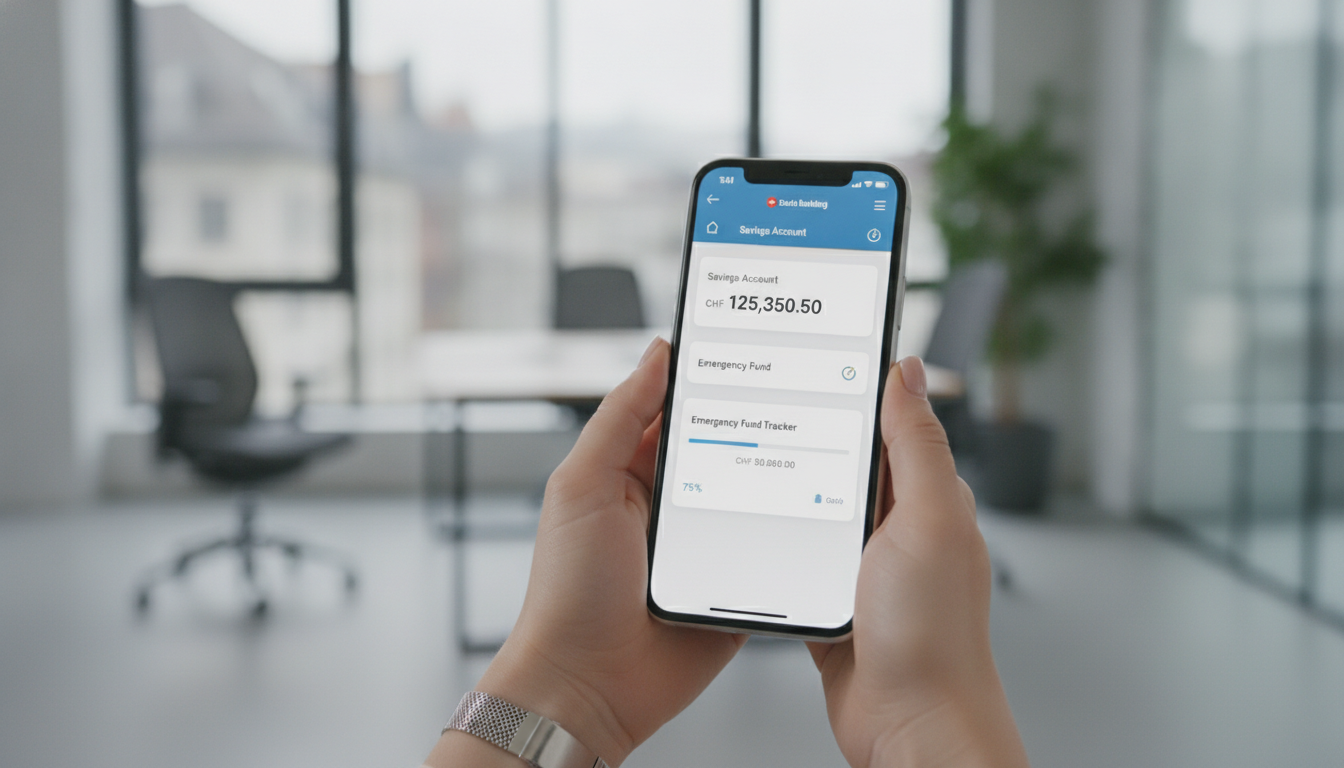
Your emergency fund has to meet three criteria: safety, availability, inflation protection. The classic savings account meets the first two well, while inflation protection is currently lacking. With interest rates around 0.5 to 1.0 percent, you lose purchasing power in real terms, but that's the price of immediate availability.
I've split my $18,000 across two accounts. $12,000 sits in a savings account at 0.6 percent interest. The remaining $6,000 I've put in a three-month CD at a credit union at 1.1 percent interest. That way I have an immediately available part and a second part with somewhat better interest.
I don't think much of the stock market for emergency reserves. In March 2020, many stock indices lost over 20 percent within a few weeks. Anyone who had just lost their job at that moment and had to sell stocks realized massive losses. Your emergency fund isn't an investment, it's insurance.
Emergency fund vs. debt: what comes first?
This question occupies many readers. My answer is nuanced. If you have consumer debt with high interest, say on a credit card at 20 to 25 percent, build a mini emergency fund of $1,000 to $1,500 in parallel and then pay down your debt aggressively. Without this mini-buffer, you slide deeper into debt at every small emergency.
I did exactly that in 2019. My $8,000 in credit card debt cost me over $140 a month in interest. At the same time I had zero savings. I first saved $1,200 as an emergency minimum, then put every available dollar toward paying off debt. After eleven months I was debt-free. I describe the strategy in detail in my post on reverse planning when paying off debt.
If, on the other hand, you have a mortgage at a low interest rate of 3 percent, definitely prioritize the emergency fund. The return of an emergency cushion lies not in interest, but in avoided emergency loans and peace of mind. This math always works out.
The psychology behind financial security
Building financial security through an emergency fund changes not just your bank account but your whole behavior. Today I make different decisions than five years ago. Back then I lived paycheck to paycheck, and every unexpected bill triggered stress. That permanent feeling of insecurity affected my work, my relationships, my health.
Today I have a clear head for important decisions. When a client canceled a project last year, I was able to stay calm and start new outreach instead of panicking and accepting every job. This negotiating position is priceless. It arises solely from your safety cushion.
Studies show that people with sufficient savings make more rational financial decisions. They're less likely to fall for overpriced emergency loans, choose better insurance and invest with a longer horizon. Your emergency fund is thus also a lever for all your other financial decisions.
When are you allowed to touch your emergency fund?

The line between emergency and want is sometimes blurry. My rule: the emergency fund is exclusively for unforeseeable, necessary expenses. Broken washing machine? Yes. New iPhone because the old one is scratched? No. Job loss? Yes. Spontaneous vacation to Bali? No.
I mentally keep two categories: real emergencies and plannable big expenses. For plannable things like a new winter coat, Christmas gifts or the annual dentist bill, I have separate sub-accounts. Only real emergencies that I couldn't have foreseen justify dipping into the emergency reserve.
If you do withdraw money, refill the emergency fund right away. In 2022, after water damage in my apartment, I had to front $2,400 until the insurance paid. In the following three months I saved an extra $800 each month to close the gap. Your safety cushion only works if it's actually complete.
Emergency fund and lifestyle: the most common thinking error
Paradoxically, many people with high incomes don't have sufficient savings. I know lawyers with $180,000 annual salaries who wouldn't survive two months without a paycheck. The reason: their lifestyle scales with income. Bigger apartment, more expensive car, more frequent restaurant visits. More on this in my article about the lifestyle trap at high income.
Your emergency fund should secure your current standard of living, but that standard of living shouldn't automatically rise with every extra dollar of salary. Today I earn twice as much as in 2019, yet my monthly fixed costs have only risen by 15 percent. The difference flows into investments and additional safety reserves.
This deliberate decoupling of income and spending creates real financial security. It allows you not to have to overhaul your entire lifestyle immediately even if income drops. That's the difference between apparent and real prosperity.
Frequently asked questions about emergency funds and financial security
How big an emergency fund do I really need as a self-employed person?
As a self-employed person, you should set aside at least six months of fixed costs, preferably nine months. Your income fluctuates more, you have no notice period and typically no claim to unemployment benefits. I personally keep about eight months of expenses as a reserve because I work in a project-based business.
Should I hold my emergency fund in a foreign currency?
No. Your emergency fund must be available in US dollars, because your ongoing obligations are in dollars. Currency risk has no place in an emergency fund. Diversification is important for investments, not for emergency reserves.
How big should the financial reserve be if I have children?
With children I recommend six full months of expenses. Children mean additional unpredictable costs: orthodontics, tutoring, broken smartphones, class trips. Plan an additional $2,000 to $3,000 of buffer per child.
Can I use my emergency fund for a down payment on a home?
No, that isn't an emergency. Save for the down payment in parallel. If you use up your emergency fund, you'll be without a safety net after buying the property. That's exactly when unexpected renovation costs are guaranteed to show up.
Calculating an emergency fund for financial security: do variable costs count?
Yes, but adjusted realistically downward. In an emergency you don't need Netflix, a gym membership or weekly restaurant visits. Calculate with 60 to 70 percent of your current variable costs. For me that means: instead of $800 for leisure and eating out, I plan $500.
Conclusion: your financial security starts today
Financial security isn't an abstract goal but a concrete number in your account. That number is three to six months of expenses, depending on your life situation. Building it takes months, sometimes years. But every dollar saved gives you back a bit of peace.
Start today. Open a separate savings account, set up an automatic transfer, and pay yourself first. Your future self will thank you when the next washing machine gives up the ghost or the next unexpected bill arrives. That's the moment when your emergency fund pays off: not in interest, but in peace of mind.