Tax Return: Use Deductions to Ease Money Worries

Reading time: 9 minutes
Last year at the end of February I sat down to my tax return in Switzerland and thought only: "Another 800 francs to pay." Until I went through all the deductions systematically and suddenly got 1,240 francs back. That difference helped me pay off my ongoing debts faster. I'll show you concretely how to reduce money worries through targeted deductions on your Swiss tax return.
Most people on a tight budget believe tax optimization is only for high earners. The opposite is true. Especially when every franc counts, getting a refund instead of owing more makes the decisive difference. The Swiss Federal Tax Administration (FTA) counts over 120 different deduction items, many of which specifically relieve small and medium incomes.
Why the tax return is especially important when you have money worries
When I consciously checked all Swiss tax deductions for the first time three years ago, my monthly expenses were higher than my net income. I lived from one credit card overdraft to the next. Filling out the tax return correctly meant survival for me back then, not optimization. Owing more would have driven me into a debt spiral, while a refund gave me room to breathe.
According to the Swiss Federal Statistical Office (FSO), around 8.7 percent of the Swiss population were affected by income poverty in 2022. That is over 745,000 people who have to get by on less than 2,289 francs a month (single-person household). For this group, tax refunds are not a lifestyle upgrade but often the only larger sum of money in the year.
The most important deductions I use when money is tight
I focus on deductions that work even with a small income. Not everyone can deduct Pillar 3a contributions or large donations. But these items are open to everyone.
Claim work-related expenses correctly
The flat-rate deduction for work-related expenses is at least 2,000 francs (canton of Zurich) or 3 percent of net salary. But I always claim actual expenses if I can document more. My public transportation costs me about 2,880 francs a year (zones 110/121; the GA annual travelpass currently costs 3,995 francs, I use the half-fare card with single tickets). On top of that come further education, professional literature, work clothing. Last year I came to 4,100 francs in actual work-related expenses, 2,100 francs more than the flat rate.
If you take a professional training course on a tight budget, document every franc. Course fees, teaching materials, exam fees, even the trips to the course location are deductible. In 2023 I did a CAS (Certificate of Advanced Studies) program for 4,500 francs and was able to deduct the entire sum.
Use medical expenses and deductibles
Medical expenses are deductible to the extent they exceed 5 percent of net income (federal tax, varies by canton). With a net income of 50,000 francs, that would be from 2,500 francs. This includes all out-of-pocket costs, deductibles, dentist bills, glasses, non-reimbursed medication.
I collect all health insurance statements, all pharmacy receipts, all dentist invoices in one folder. In 2023 I had dental treatment for 1,800 francs, a health insurance deductible and co-payment of 1,400 francs, glasses for 620 francs. Total 3,820 francs. With my net income of 48,000 francs, that was 1,420 francs above the 5-percent threshold, so fully deductible.
Insurance premiums and Pillar 3a
Health insurance premiums are fully deductible. For me that is 5,280 francs a year (440 francs a month, basic insurance in the canton of Zurich). Added to that are premiums for the second and third pillars, life insurance, legal expenses insurance.
If you contribute to a small Pillar 3a despite money worries, deduct that too. I pay in 100 francs a month, 1,200 francs a year. That reduces my taxable income, and at the same time I build an emergency fund that is protected from creditors.
How do I fill out the tax return correctly when I have money worries
I do my Swiss tax return every year in February, as soon as I have all my documents together. Filing early has two advantages: I get any refund faster, and I avoid late fees on amounts owed.
My process looks like this:
- Collect all salary statements, account statements, insurance documents (January)
- Go through the medical expenses folder, add up the total
- Document work-related expenses: travel passes, training receipts, professional literature
- Fill out the online tax return, enter all deductions
- Check whether the expected tax is right
- Submit, print the confirmation
I use the cantonal online platform (in Zurich: eSteuern) because the system calculates automatically and runs plausibility checks. Errors stand out immediately. I also see in real time whether I have to pay more or will get a refund.
Which deductions help me with financial problems
If you're suffering acutely from money worries, concentrate on these three areas: claim work-related expenses at actual cost instead of the flat rate, document all medical expenses meticulously, enter insurance premiums in full. For me, these three items regularly make up the largest part of my deductions.
Another point many people overlook: interest on debt is deductible. If you're paying off a loan, you can claim the interest (not the principal) for tax purposes. On a consumer loan of 10,000 francs at 8 percent interest, that's 800 francs a year. That lowers your taxable income and therefore your tax burden.
Optimizing tax deductions on a tight budget in Switzerland
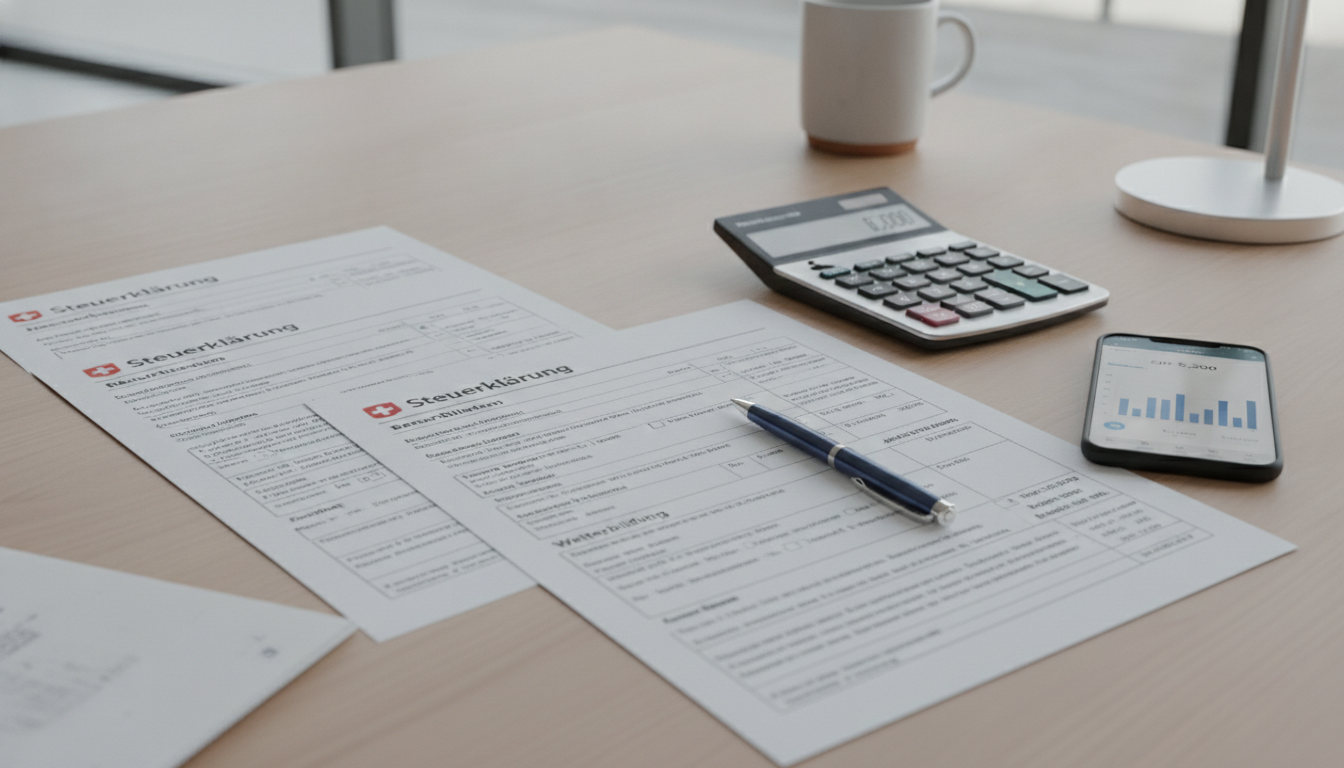
Optimization sounds like a luxury problem, but it isn't. I've learned that on a tight budget, every additional deduction counts. My most important takeaways from recent years:
Collect receipts, don't estimate
I have a simple filing system: one folder per year, divided into work, health, insurance, miscellaneous. Every receipt goes in right away. At year end I have everything within reach. Estimating is risky. The tax office can ask for receipts, and if you don't have them, deductions are struck.
Don't underestimate small amounts
A single receipt for 15 francs isn't worth it. But 20 receipts of 15 francs each add up to 300 francs. At a marginal tax rate of 20 percent, you save 60 francs in taxes. That sounds small, but when you want to reduce your spending and save on taxes at the same time, every franc counts.
Use the deadline, don't sit it out
The filing deadline for the tax return is normally the end of March (it can vary by canton, in Zurich it is March 31). An extension is possible, but I advise against it. The longer you wait, the greater the danger that you lose or forget receipts. Also, a refund comes faster if you file early.
Financial relief through taxes: my concrete example from 2023
My gross income is 62,400 francs a year; after AHV, IV, EO and ALV social insurance contributions, 56,100 francs net remain. My net income for the tax return after all deductions was 38,200 francs. Here's how I got there:
Work-related expenses at actual cost: 4,100 francs (instead of the 1,870 franc flat rate). Health insurance premiums: 5,280 francs. Medical expenses minus deductible: 1,420 francs. Pillar 3a: 1,200 francs. Other insurance (legal expenses, household contents, liability): 840 francs. Interest on consumer loan: 680 francs. Total deductions: 13,520 francs.
The cantonal tax (Zurich, city of Zurich) at 38,200 francs of net income was 2,890 francs, the federal tax 320 francs. Without deductions I would have paid significantly more on 56,100 francs. I got a refund of 1,240 francs because I had overpaid withholding tax.
I put these 1,240 francs straight into paying off debt. Without correct use of all deductions, that money would have stayed with the tax office.
Common mistakes that cost me money at first
I didn't always get everything right. My biggest mistakes in the first years:
Flat rate instead of actual-cost claim
I thought the flat rate was simpler and safer. But I gave away several hundred francs a year that way. Since I claim actual costs, I consistently save more taxes.
Not collecting medical expenses
For the first two years I threw away pharmacy receipts and dentist invoices. I didn't know they were deductible. That cost me an estimated 600 francs a year.
Filed too late
Once I filed my tax return only in June. The refund didn't come until November. In the meantime I had to use an expensive overdraft because I was relying on the money. Timing matters.
Tools and help I use
I'm not a tax expert, but over the years I've built up a system. These tools help me:
The cantonal online tax return (eSteuern Zurich) calculates automatically and flags errors. The official guide from the FTA explains every deduction in detail (downloadable as a PDF). I also use a simple Excel spreadsheet where I keep entering work-related expenses and medical costs. That way I already know in November whether I'll have to pay more or get a refund.
If you're unsure, many municipalities offer free tax advice. In Zurich there's the contact point for people without a residence permit (AOA), which also answers basic tax questions. It costs nothing and often helps more than expensive advisors.
Swiss tax return tips for small incomes

If your income is below 50,000 francs, the same deductions apply, but every franc counts double. My three most important tips for small incomes:
First: use all social deductions. If you have children, claim the child deductions (Zurich: 9,000 francs per child). If you're a single parent, the single-parent tax rate applies on top. Second: check whether you're entitled to premium subsidies. This doesn't directly reduce your tax burden, but it relieves your budget and gives you more room. Third: always file your tax return, even if you think you earn too little. That's the only way to get refunds.
How do I save on taxes despite money worries in Switzerland
Saving on taxes sounds paradoxical when money is already tight. But that's exactly when it matters. I've learned that tax optimization isn't a privilege of the rich but a tool for anyone who wants to keep their money together.
The most important lever is knowledge. I read through the guide to the tax return (admittedly dry, but important) and checked every deduction that could apply to me. I talked to colleagues in similar situations. I asked in an online forum (comparis.ch/steuern) how others claim their work-related expenses.
The second most important lever is discipline. Collecting receipts is annoying, but it pays off. I've built a routine: every month I file all my receipts, every December I do a preliminary calculation, every February I file.
FAQ: tax return when you have money worries
Do I have to file a tax return if I earn little?
Yes, in most cantons the tax return is mandatory regardless of income. That's the only way to reclaim overpaid withholding tax and benefit from deductions.
Can I deduct interest on debt from my taxes?
Yes, interest on debt (not the principal) is deductible. This applies to consumer loans, mortgages, lease interest. Document the interest burden with account statements or loan statements.
What happens if I file my tax return too late?
You'll receive a reminder and possibly a late fee (in Zurich up to 100 francs). With repeated failure, the tax office can estimate your income, often to your disadvantage. It's better to file on time.
How long does it take to get a tax refund?
That depends on the canton. In Zurich I normally get the refund 3 to 5 months after filing. The earlier you file, the faster the money comes.
Is a tax advisor worth it on a small income?
Usually not. Tax advisors cost between 200 and 500 francs per tax return. With an income under 60,000 francs, the tax return isn't complex enough to justify that amount. Use free advisory services from your municipality or online tools instead.
Conclusion: the tax return as a tool against money worries
By systematically using all the deductions on my Swiss tax return, I didn't solve my money worries, but I clearly reduced them. The 1,240 francs refund in 2023 helped me pay off a loan faster. Every franc I don't pay to the tax office I can invest in my financial stability.
My most important advice: start today. Set up a folder, collect all receipts from now on, read the guide, fill out the tax return carefully. It may cost you three hours a year, but it often brings back several hundred francs. If you want to know more about paying off debt, read my article on reverse planning for debt. Filling out the tax return correctly is a concrete, measurable step out of money worries.